
Inside the Hartford County Most Wanted Program
Hartford County has no countywide most-wanted roster. Connecticut did away with county sheriffs, so no sheriff's office here runs a fugitive page. What exists is statewide instead. The Connecticut State Police maintains an official Information Wanted program that highlights selected matters and asks the public for tips. It is a curated list, not a warrant file. A missing name proves nothing about court status, and nobody should read the page as a full count of outstanding warrants. Local police departments in Hartford County can also post their own notices. For a real warrant check, the court or the department holding the warrant is still the place to ask.
Hartford County Uses a State Tip Program
Curated is the key word for the State Police program. An officer picks which matters get public attention. There is no automatic feed drawn from court warrant records. A notice may seek an identification, a location, or details tied to one investigation, and its presence reflects an agency request rather than a ranking of every active warrant. Because the program covers the whole state, an item may have no Hartford County connection at all. The reverse also holds. A Hartford County bench warrant can stay active without ever appearing there. Local departments in Hartford, New Britain, Bristol, West Hartford, and Manchester may hold their own information, and Superior Court clerks keep the related dockets. When a notice names a source agency, send tips to that agency, not to some other Hartford County office.
Program scope: Connecticut State Police tip notices are selected public requests, never a full Hartford County active-warrant search.
How Hartford County Most Wanted Lists Work
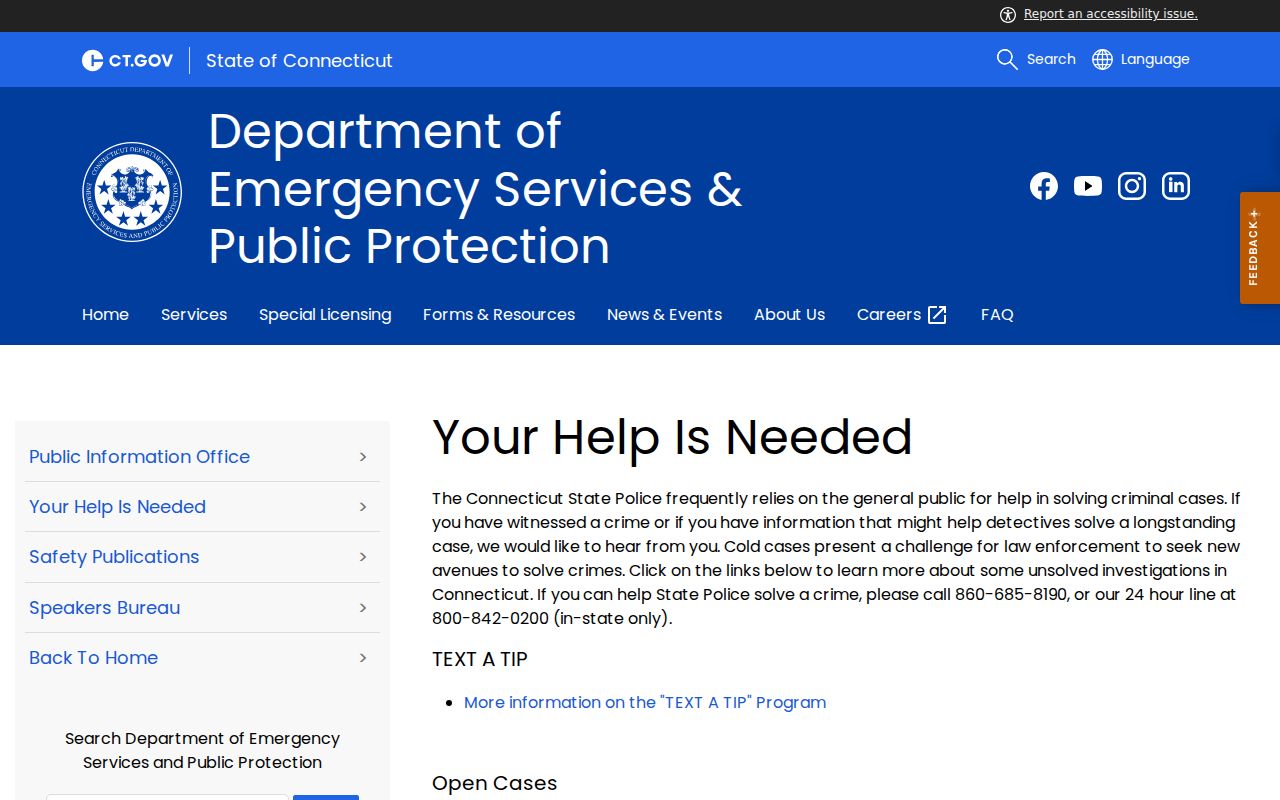
What appears on a Hartford County most wanted page is up to the police agency that runs it. The agency decides what to post, how long a notice stays up, and when it comes down. A listing can change after an arrest, new evidence, a court action, or a simple editorial update. So trust the agency's own page rather than a saved image or a third-party profile, which can linger online after the official item has changed. For tips on a state notice, the State Police “Your Help Is Needed” page gives official instructions and safety language. Local matters belong with the local police agency that published the notice. Emergencies go to 911, never a web form or a delayed records request. Note: Save the official page address and notice details when you report, but do not repost personal information or start an independent search.
Hartford County Tip Page Limits
A tip page and a warrant search answer different questions. One asks whether you can help police with a chosen matter. The other asks whether a specific public record or pending case exists in the court files. Neither gives a complete view of Hartford County warrants. Treat each tool for exactly what it covers.
| Feature | Official tip page | Court warrant search |
|---|---|---|
| Purpose | Gather useful public tips | Show a limited slice of court data |
| Who selects entries | Publishing police agency | System rules and public access limits |
| Coverage | Selected notices | Limited warrant classes |
| Best use | Send a relevant tip | Begin checking your own status |
| Blank result | No inference about warrants | No proof of clearance |
The Judicial Branch VOP/FTA portal withholds FTA warrants until further notice. In Hartford County and everywhere else, a blank search result there proves very little.
Sending a Most Wanted Tip Safely
Send tips through the channel named on the current notice. Connecticut State Police posts a tip line at 860-685-8190, a 24-hour in-state line at 800-842-0200, and the text route TIP711 to 274637. Give plain facts: which notice you saw, when and where you observed something, and how police can reach you to clarify the report. Before dialing, open the current State Police tip page, which carries the official safety language and contact details.
The official page stays the reliable contact point, since copied numbers and reposted notices go stale. Never follow, confront, detain, or enter property to learn more about anyone named on a Hartford County notice.
Safety first: Call 911 for an immediate threat. Otherwise use the official tip channel and let trained officers assess the information.
No Hartford County Roster Exists
No dedicated Hartford County most-wanted roster exists. Resist the urge to fill that gap with names from news stories, social media, mugshot sites, or commercial people-search pages. Those listings can be stale, incomplete, or detached from what the issuing court shows today. Connecticut's structure makes a single county list a poor fit anyway. Hartford County spans several Superior Court regions. Hartford GA14, Manchester GA12, New Britain GA15, Bristol GA17, and the Hartford Judicial District each handle different towns and case levels. On enforcement, local police and State Police serve criminal warrants, while state marshals serve many civil capias matters. A capias is civil court process and belongs on no criminal most-wanted roster. The honest move is to skip the invented list. Anyone searching Hartford County should use the state tip channel or a court status path instead.
How Most Wanted Differs From an Active Warrant
A most-wanted page is a choice about publicity. An active warrant is a legal status held in court and law-enforcement systems. Someone can carry an active Hartford County warrant and stay off any tip page, and a notice can linger online after the agency refreshes its list.
| Most wanted | A selected public notice intended to generate tips. |
|---|---|
| Active warrant | An outstanding court order that has not been served or withdrawn. |
| FTA warrant | Process tied to a missed court obligation; currently withheld from the public VOP portal. |
| Served warrant | A warrant that officers executed; the underlying case may still be pending. |
| Recalled warrant | A warrant the issuing court withdrew. |
The Hartford County active-warrant reference covers the few public court tools and why the clerk's confirmation still matters. Use neither type of page to confront anyone.
Hartford County PRAWN Is Different
Connecticut runs its Paperless Arrest Warrant Network as an operational tool for authorized officers, and Hartford County police tap into it daily. It is not the State Police information-wanted page. There is no public person search, and the service-attempt logs stay closed. That gap matters for residents. An active warrant can exist in the system yet never surface on a tip page or a limited court portal. Still, no Hartford County resident can demand a login to the operational network. Public records flow through court rules, the Connecticut Freedom of Information Act, lawful exemptions, and redaction. For your own status, the issuing court remains the key source.
- Tip program
- A selected public request for information.
- PRAWN
- Connecticut’s restricted law-enforcement warrant network.
- Public portal
- A limited Judicial Branch search available without agency credentials.
- Official record
- The record maintained and certified by its originating court or agency.
Hartford County Tips Do Not Resolve Warrants
A tip does not resolve anything. Hartford County tip lines exist to pass information to officers, not to serve, recall, or clear a warrant. Only the responsible officers and the issuing court can change a warrant's status. A reward changes nothing about the court case either. Follow the exact terms the agency publishes, and never assume anonymity or reward eligibility unless the official notice says so plainly.
A deleted notice proves just as little. The listing may have come down for an editorial update while the warrant still stands. A clerk can confirm public docket events; a lawyer can tell you what they mean. When police records are lawfully available but not online, the Connecticut FOIA request instructions show how to send a focused request to the Hartford County agency holding the record. Note: Ask for a specific public record, not access to the restricted PRAWN system or an investigative file.
When You Believe You Are Listed
Think an official notice names you? Do not call the tip line to negotiate. Do not send a friend to test the listing. Save the official URL and any visible agency or case reference first. Then reach out to a Connecticut criminal defense lawyer. Counsel can contact the right police agency or Superior Court clerk, verify the legal status of any Hartford County warrant, and plan a safe response. For your own status, start with the Judicial Branch VOP/FTA portal, but read its FTA-withholding and completeness notices. Search the pending criminal docket, identify the correct Hartford-area court, and call the clerk. Hartford County has no sheriff desk that clears warrants.
- Confirm that the page is an official state or local police source.
- Save the agency name and any public reference number.
- Speak with counsel before arranging contact or a voluntary appearance.
- Use the issuing court to confirm the latest public warrant status.
- Follow the lawyer’s and court’s instructions for surrender, bond, recall, or the next hearing.
Showing up fixes custody, not the case. An appearance or bond in Hartford County addresses process only. The charge stands until the court resolves it.