
Hartford County Warrant Checks
A good Hartford County warrant check stacks layers. Open the Connecticut Judicial Branch criminal information page first. From there you reach the VOP warrant portal, pending criminal and motor-vehicle cases, daily dockets, conviction searches, and court directories. No single tool lists every warrant type. Gather a full legal name, a birth year, any old notice, a docket number, the reported town, and the likely court, then work the steps in order.
- Search the public VOP/FTA portal and read its current coverage notice.
- Search pending cases by defendant and by docket number when one is known.
- Match the town to Hartford GA14, Manchester GA12, New Britain GA15, Bristol GA17, or the Hartford Judicial District.
- Call the clerk and ask for the latest public warrant status and next court step.
- Use the relevant police records unit or a narrow FOIA request when a disclosable record is not online.
The Hartford County warrant-check page walks through every search field and every fallback in fuller detail.
No Hartford County Sheriff Search
Hartford County is a map line, not a working criminal government. Connecticut abolished its county sheriffs long ago. The search path changes accordingly. Hartford County has no sheriff warrant unit, no sheriff roster, no county jail bond window, and no county warrant hotline. Superior Court clerks hold the court records. Hartford, New Britain, Bristol, West Hartford, Manchester, and other municipal police departments may keep local service or incident files. Connecticut State Police handles matters within its own authority. State marshals serve many civil capias papers, judicial marshals work inside the courthouses, and the agency holding one piece often cannot speak for the rest.
Local rule: The issuing Superior Court is the key source for current legal status; police and FOIA channels fill record gaps.
Warrants in Hartford County: The Main Types
Hartford County warrants come in a few forms, and each starts with different facts and leads to a different office. A criminal arrest warrant grows out of a probable-cause application under Connecticut General Statutes §54-2a. A missed court date can bring a bench or rearrest warrant. A VOP warrant targets an alleged probation violation.
| Type | Usual basis | Primary confirmation |
|---|---|---|
| Arrest warrant | Probable cause for an alleged offense | Issuing court and serving police agency |
| Bench or FTA warrant | Missed appearance or court order | GA or Judicial District clerk |
| VOP warrant | Alleged probation violation | Court and probation record |
| Capias mittimus | Civil or family-support order | Civil clerk and state marshal |
| Search warrant | Authority to search on probable cause | Court or investigative record when public |
A search warrant authorizes a search, not an arrest. And a Hartford County civil capias is not a normal criminal warrant.
The Hartford County FTA Search Gap
The free Judicial Branch VOP/FTA portal has limits. Its own notice says FTA warrants will not be displayed until further notice. The page also warns that it does not hold every warrant type. Data can change without notice. So a blank result proves little about Hartford County warrants. The state's own warrant-search page spells out those boundaries, so view the official warrant-search source there.
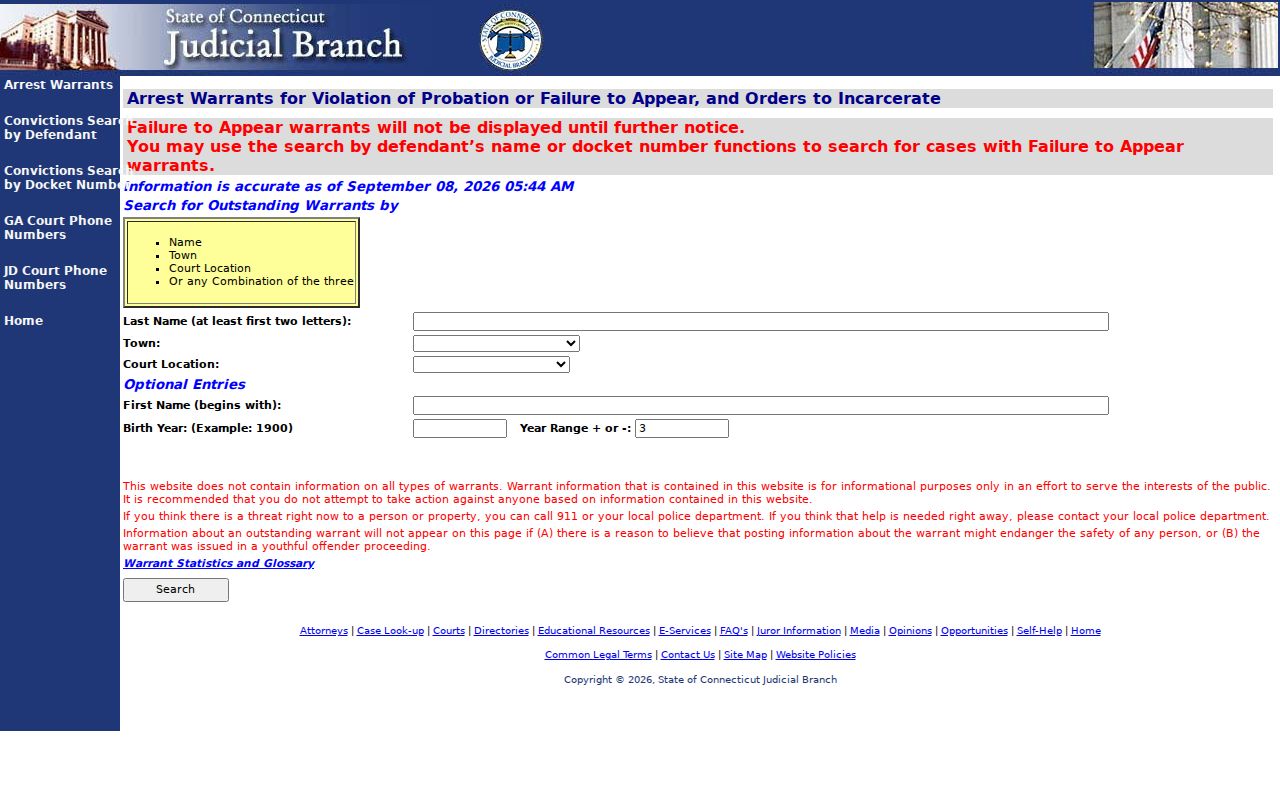
That notice is exactly why the docket search and the clerk call still matter. A missed appearance can surface through the case file. The warrant itself stays hidden the whole time.
Hartford County Warrant Records: What They Show
Public Hartford County warrant records vary in what they expose. Expect identity fields, a court location, a docket or case number, a process label, an issue date, an alleged offense, and sometimes bond data. Screens differ. Not every screen shows every field. The form does not promise a judge name, a serving agency, a full address, a photograph, or a complete service history.
| Docket number | The strongest key for clerk confirmation, such as H14H-CR-0000000-S. |
|---|---|
| Court location | The GA or Judicial District tied to the case. |
| Process label | Arrest warrant, bench warrant, FTA, VOP, OTI, capias, or another court term. |
| Issue or event date | The recorded date of a warrant or docket action. |
| Status | Active, served, recalled, returned, or resolved when the public record includes it. |
| Bond | A court-set term that must be confirmed before anyone acts. |
Online screens are helpful, but only the clerk's certified record is the official Hartford County court file.
Hartford County Court Location Matters
Hartford County covers several Superior Court territories. Hartford GA14 takes Hartford, Bloomfield, West Hartford, Windsor, and other Hartford County towns. Manchester GA12 covers East Hartford, Glastonbury, Manchester, Marlborough, and South Windsor. New Britain JD/GA15 serves New Britain, Bristol, Newington, Plainville, Rocky Hill, Southington, Wethersfield, and nearby towns. Bristol GA17 handles the Bristol end of Hartford County. The Hartford Judicial District handles serious Part A matters. Old Hartford County paperwork can point elsewhere entirely. Check the current Judicial Directory before travel, because Hartford County assignments and contact details can change.
Hartford GA14
101 Lafayette Street, Hartford. Clerk: 860-566-1630.
Manchester GA12
410 Center Street, Manchester. Clerk information: 860-647-1091.
New Britain GA15
20 Franklin Square, New Britain. Directory line: 860-515-5080.
Bristol GA17
225 North Main Street, Bristol. Confirm the current clerk line in the directory.
Hartford County Warrants: Who Issues, Who Serves
A Connecticut Superior Court judge signs a criminal warrant. A prosecutor or police investigator may file the application, but only judicial approval gives the warrant its force. Local and state police serve criminal warrants. The clerk records court events and confirms the public docket. New Britain Police, in Hartford County, shows how the pieces fit. Its Investigative Division page says detectives apply for and serve search and arrest warrants. That still is not a public warrant list. A civil capias moves on a separate track, often through a state marshal following the State Marshal Commission capias guidance.
Warrant flow: police or prosecutor applies → judge reviews → clerk records → police serve criminal process or a state marshal serves qualifying civil process → court records the next event.
Hartford County PRAWN Stays Private
Hartford County sits inside a network most residents never see. The Paperless Arrest Warrant Network links municipal police, State Police, and more than 140 criminal-justice agencies, moving warrants between them electronically. It started with failure-to-appear warrants and grew to cover more court warrants and orders. Open the state description of PRAWN to see exactly where the public side of the system ends.
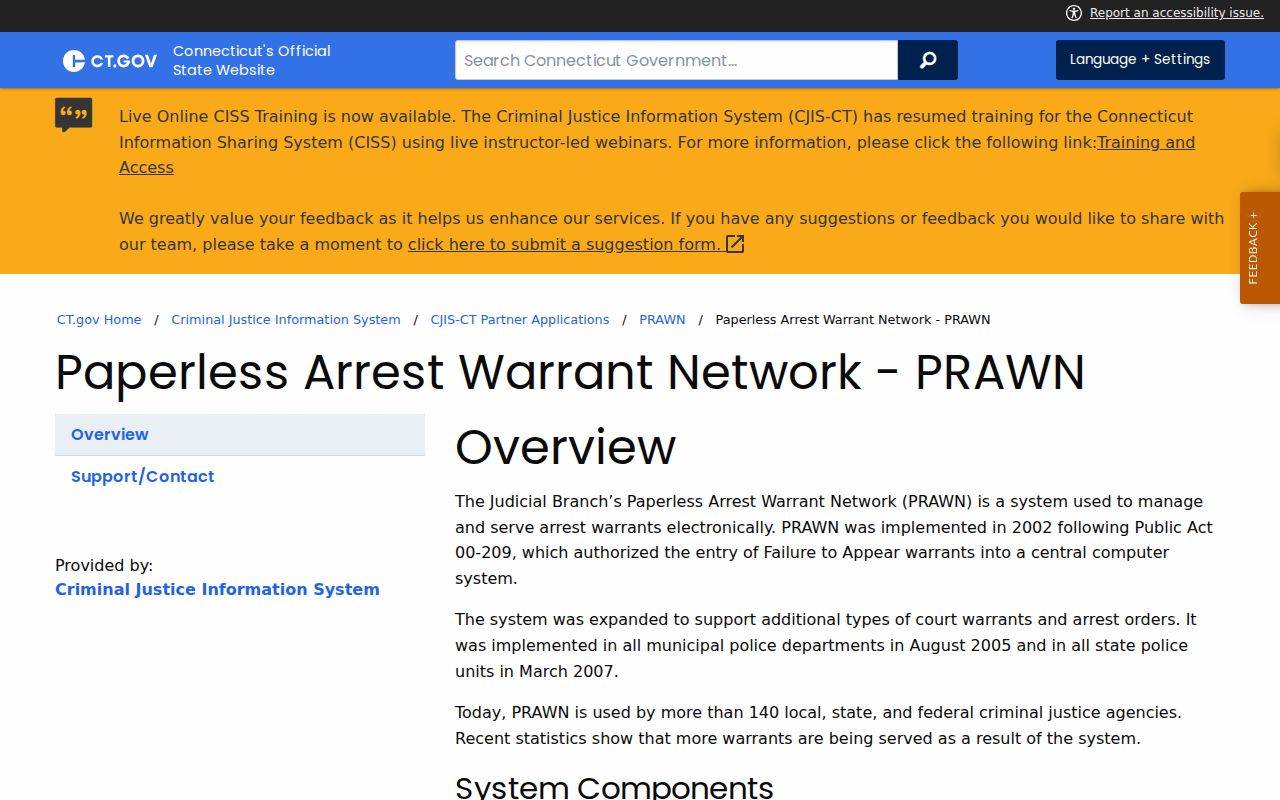
PRAWN offers no public window at all. Its service-attempt data cannot replace a public court record, and a FOIA request does not guarantee access to restricted operational material. Public warrant checks in Hartford County run on court tools. Agencies share only what the law lets them disclose.
Handling a Hartford County Warrant
A confirmed Hartford County warrant in your name calls for a plan, not a rush. Write down the docket number, the warrant label, the issuing court, the issue date, and any bond amount before you do anything else. Then call a Connecticut criminal defense lawyer. Go to no courthouse or police desk first. Counsel can find out what the court expects, whether that means a new appearance, voluntary surrender, posting bond, or a motion to recall the warrant. Hartford County also offers procedural help at the Court Service Center, 90 Washington Street in Hartford, though that office cannot cancel anything. Hartford GA14 lists a clerk at 860-566-1630, bail at 860-566-4966, and night bail at 860-305-5974. Those numbers reach court staff. They are not a county jail window.
Do not walk in without a plan: Verify the court, consult counsel, and follow the issuing court’s directions for appearance, surrender, or bond.
Posting bond only concerns release in Hartford County. It does not end the charge or close the case.
Before Visiting a Hartford Court
Call before you visit any Hartford County courthouse. No office here advertises a countywide walk-in warrant window, and 101 Lafayette Street does not handle every GA12, GA15, GA17, civil, juvenile, or sealed matter. So ask which building, clerk, or custody route fits your case. Bring photo identification, the docket number, old notices, and your lawyer's contact information. Every visitor passes courthouse security, and official guidance bars pocketknives, scissors, and similar items while requiring phones to stay off. Plan on a public garage, lot, meter, or street space for parking. If you need access help or an interpreter, confirm it with the court directory or service center before leaving home. One more thing. A civil or family-support capias runs through the civil or Family Support Magistrate route, along with state marshal information, because a criminal clerk cannot cancel civil process. A municipal police desk cannot recall a judge's criminal warrant either.
Warrant Record Access Under Connecticut Law
Connecticut law presumes that records kept by public agencies are open, and the Connecticut Freedom of Information Act is the starting point. Section 1-210 governs access generally, §1-212 addresses copies and fees, and §1-215 addresses arrest records. Court sealing orders and statutory limits still control what comes out. Sealed, juvenile, youthful-offender, victim, witness, and exempt investigative material may be withheld or redacted, even in Hartford County. Ask the agency that holds the record for something narrow rather than a bulk roster. Copies from municipal agencies may cost up to $0.50 per page, while state or Judicial records run up to $0.25 per page. Certified-copy and prepayment rules can apply too. Note: FOIA reaches existing public records and cannot force an agency to give legal advice or create a new warrant-status certificate.
Use Hartford County Police Records Carefully
Police records fill part of the gap in Hartford County, but they are not a universal warrant check. Hartford Police Records offers a report-request route and may redact or withhold protected material. New Britain Police Records takes requests in person or by mail. Bristol Records also accepts them in person or by mail and posts its own form and fees. West Hartford works by mail, email, or drop-off. Manchester Police provides a local police and records route but posts no dedicated public warrant database. Aim each request at the agency that created or keeps the record. Include the docket or incident number, dates, the record type, and a request for the public portion of your own record. Keep one limit in mind. Police can serve a court warrant, yet only the issuing court can confirm whether it was recalled or what the next case step requires. Records access and warrant resolution stay two different tasks in Hartford County.
City Warrant Records in Hartford County
Cities in Hartford County still route their warrant records through Connecticut Superior Court. None of these cities runs its own municipal criminal court. Each one has a police contact and a likely GA or Judicial District path, listed below in 2020 Census population order.
New Britain
New Britain Police and New Britain GA15/JD serve the city route.
West Hartford
West Hartford Police and Hartford GA14 serve the town route.
A Hartford County city police building may hold a report its officers wrote. The clerk confirms court status. Check the city profile before picking a court location on the state form.
Hartford County Warrant Terms
Connecticut warrant labels can point to very different legal paths. Record the exact term. A generic word can send a Hartford County clerk to the wrong file and blur civil process with criminal process.
- FTA
- Failure to appear at a required court setting.
- VOP
- An alleged violation of probation.
- OTI
- Order to Incarcerate, a distinct court or probation process label.
- Capias mittimus
- Civil or family-support process often served by a state marshal.
- Recalled
- The court has withdrawn the warrant.
- Bond
- A financial or nonfinancial release condition set by the court.
"Served" does not mean "case closed" in Hartford County. It means officers executed the warrant, and the defendant may still face arraignment, bond terms, future appearances, and resolution of the underlying charge.